Full Scored Debate Rounds on Zero Budget When Your School Has No Team and No Staff
AI-judged online rounds let students practice debate without school support.
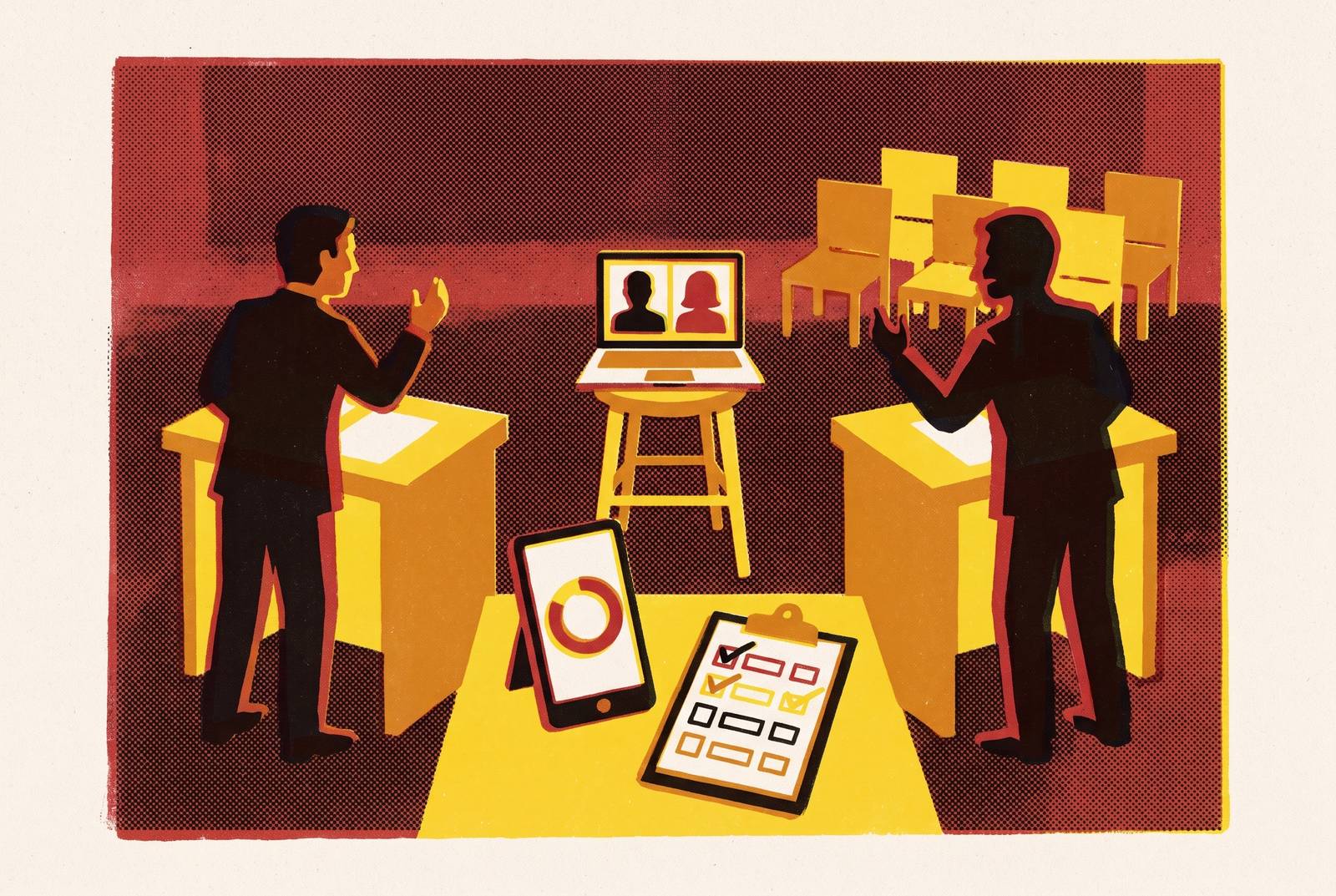
Students at schools with no debate team, coach, or budget can take part in full scored rounds for free through AI-judged online practice. With structured formats, human or AI opponents, published scoring criteria, and written verdicts, students can start without the school support they would usually need. Free preparation tools complete the path, allowing underfunded high school programs and independent students to practice without first building a staffed team.
Why students at schools with no debate team face a structural access problem, not a personal one
Students need more than the will to work hard to get the resources competitive debate calls for. Coaches teach structure, opponent pools provide practice, and tournament budgets buy access to competition. Camps, private coaching, preparation databases, and experienced judges deepen that advantage. A private-school student with a developed research pipeline and on-the-spot coaching enters on different terms from an equally capable student without either.
Starting a team requires staff time, administrative approval, and recurring funding that some schools cannot provide or will not commit. The missing resource is an institution. However, the supply of free tools has changed, making it possible to route around those barriers for preparation and scored practice.
What a full scored debate round actually requires, and which of those requirements have now dropped to zero
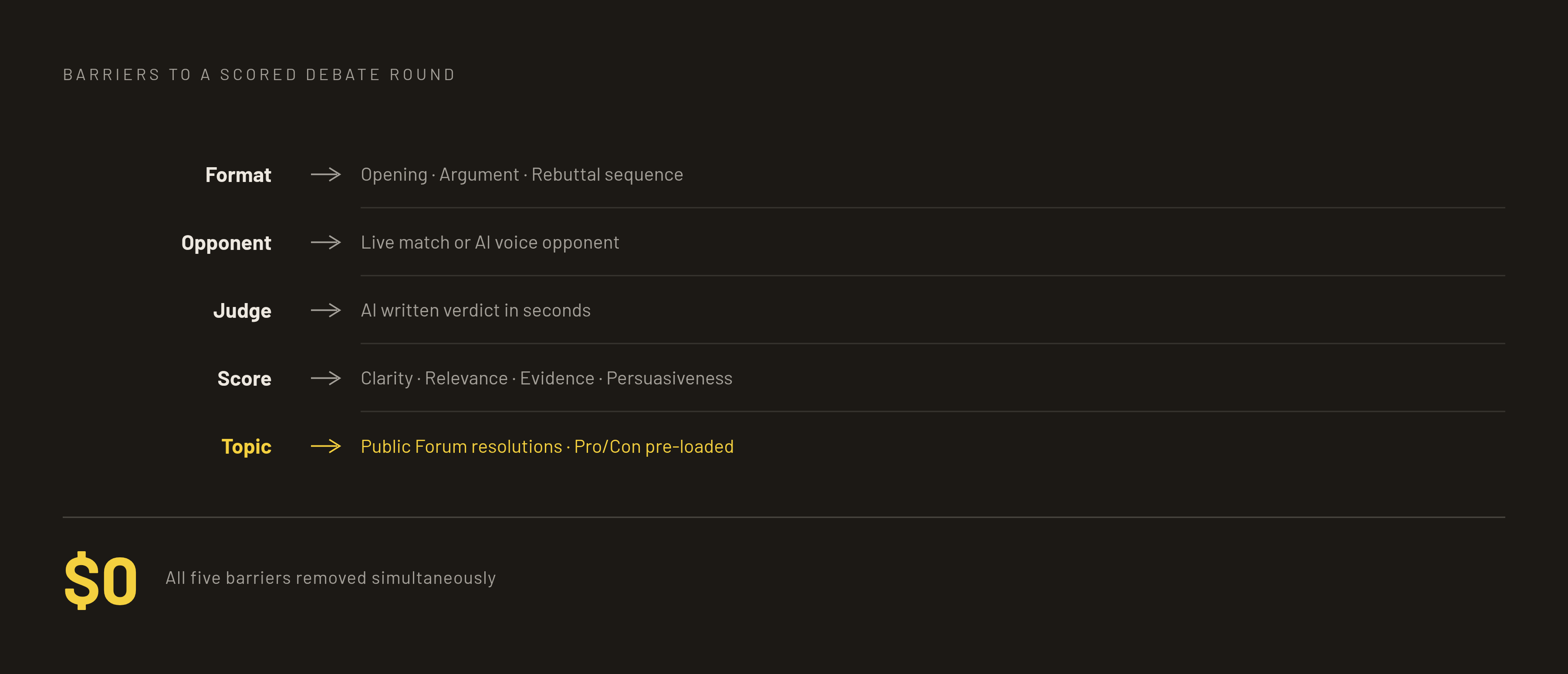
A complete scored round needs five things, which are a format, an opponent, a judge, a score with reasoning, and a topic. These are functions. Structured online rounds provide a sequence of opening statements, supporting arguments, and closing rebuttals that the AI can parse. The student therefore has a format to follow without needing a coach to establish the structure first.
The opponent can come from live matching with another person. When no human is available, an AI opponent can conduct a full timed voice round, including points of information mid-speech. That removes dependence on a local practice partner. AI judging then supplies a written verdict within seconds of the final speech, citing what was said.
The score becomes useful because its criteria are published before the round begins. Clarity, relevance, evidence, and persuasiveness give the student a rubric against which to read the decision. The topic need not be invented either. Students can choose competitive resolutions such as Public Forum questions about U.S. federal AI regulation, which come with pre-loaded Pro and Con argument frameworks. Students can use these free practice formats without paying a tournament fee or belonging to a school, though the five functions still shape how the round works.
How AI judging works and what the score means when no human judge is in the room
An AI verdict is an assessment against stated criteria. Clarity concerns jargon, run-on sentences, and ambiguous phrasing. Relevance concerns whether an argument addresses the resolution or the opponent’s last point. Evidence is how facts, examples, or logical reasoning support an argument, while persuasiveness is how well it counters the other side’s position.
The weighting also changes as the round develops. Clarity and relevance receive more weight early, while persuasiveness receives the most weight in the final round. This makes the closing rebuttal more than a recap. It is the point at which the speaker must show why the opposing case fails and why the remaining argument should prevail. A clear opening cannot by itself compensate for an unanswered objection at the end.
The judge can flag ad hominem attacks, straw man arguments, and false dilemmas without disqualifying the speaker. Because the verdict quotes the round, the student can compare the cited language with the published rubric. That gives an unsupported claim or distorted rebuttal a specific place in the record, making the feedback actionable.
There is a limit to this transparency, however. Research on AI judging documents a recency effect in which the final speaker wins more often in sequential argument formats. That pattern suggests that closing arguments receive particular weight, but it does not establish that every closing argument deserves it. Students should structure the closing rebuttal deliberately and read the verdict against the rubric. AI judging reflects how language models evaluate arguments, which is not identical to how human judges decide rounds.
Three practice modes that replace the coach, the team room, and the tournament calendar
Solo AI rounds provide the mechanics of practice without a shared schedule. The student speaks out loud, the AI responds as a voice opponent, and points of information interrupt the speeches before a judge ballot closes the round. Difficulty is adjustable for beginners and more experienced debaters. This mode also exposes possible opposing arguments before a human match. Its distinct value is repeated work on delivery, response, and timing at any hour.
Live 1v1 rounds add a human opponent. Real-time matching supplies the opponent pool that a team room would otherwise provide. A competitive ranking system gives students something to compete for in these rounds beyond what solo drills offer. Entry requires no coach, ongoing commitment, or institutional affiliation. For an independent student, this creates a way to test preparation against human opposition without waiting for a tournament.
Creator and streamer matchups serve a different purpose. Public leaderboards rank players by their best score and keep separate records for live and AI rounds. Top-ranked players enter a creator challenger pool, so consistent performance can lead to consideration for a live matchup with a creator or streamer. Selection remains a possibility. This mode gives students without teams a visible competitive record and access to a public debate culture with an audience for live performance.
Together, the modes supply different parts of a practice routine. The distinction prevents the three modes from becoming interchangeable. A solo ballot, a ranked human match, and consideration for a public matchup each provide a different reason to return to practice.
How to pick a topic and argue a side you did not choose
A current competitive resolution gives students a clear question to debate in place of a broad subject. Public Forum resolutions on U.S. federal AI regulation, for example, come with Pro and Con frameworks that help establish the two positions. Competitive debate often asks students to defend views they do not hold because it tests how well they argue regardless of what they believe.
For a student without a coach, the practical method is to flip a coin, argue the assigned side, and take the opposite side in the next round. Before students build their assigned case, steelmanning means making the strongest possible case for the other side. That exposes the objections the response must survive. Arguing both sides also develops intellectual humility and separates emotion from reasoning, which aligns with the judge’s relevance and evidence criteria. The two verdicts then reveal which arguments held up and which failed under scrutiny, supplying feedback a coach would otherwise provide.
What free tools help high school debate students prepare without a coach
Preparation requires an evidence base as well as speaking practice. Well-funded programs can rely on coaches and card libraries accumulated over years, while an independent student must build that support from the beginning. Free preparation tools address this specific gap. Their role is to help students organize evidence and learn case-building skills before entering the judged rounds.
Verbatim is a free, open-source paperless debate platform built as templates for Microsoft Word and Excel. Its v6.0.0 downloads are available for PC and Mac. The templates structure evidence cards in the format competitive judges expect. This supplies a working format for research that a team would ordinarily teach and maintain.
Deb8er is free for all students, forever, and was built by a high-school student for peers without coaches, card files, or institutional support. It extracts up to three consecutive paragraphs per card and returns Word files. Neither requires the student to inherit an established program’s card library before beginning.
DebateDrills Academy describes its mission as disrupting the “information asymmetry that defines competitive debate.” It makes debate instruction available to students with internet access rather than limiting those skills to residential camps or institutional programs. Online communities give students places to share preparation materials and find practice partners. Students from small or isolated programs can build research networks across schools.
Two competitions that accept students without an established debate program
The International Public Policy Forum (IPPF), founded in 2001, lets high school students debate public policy in writing and out loud. It is open regardless of background, school type, or prior competition experience. An established debate team is not required. Entry does, however, require at least three students and up to six from the same high school or after-school program. Its openness therefore removes the need for an existing program without making it an individual-entry competition.
Top teams advance to Finals Weekend at NYU School of Law in New York City, where they compete for a substantial grand prize. The route is relevant to students who can gather eligible peers even when their school has never maintained a debate team. Prior team history is not the gatekeeper.
The Stanford Invitational uses online technology to make a national-caliber tournament accessible to schools across the country. Debaters compete in real time and receive decisions from experienced critics nationwide. Its online format removes travel costs and geographic barriers. That is a distinct access benefit from IPPF’s openness to students without prior competition experience. Neither description establishes that every participation cost disappears or that both events accept unaffiliated individual entries, so the free practice path should not be confused with a blanket promise of free tournament entry.
What debate practice actually builds, and why it matters beyond winning rounds
Research on urban debate programs finds the largest gains among students who begin with the lowest reading scores. The potential for substantial improvement from weak initial preparation is especially relevant where school resources determine who gets regular practice and feedback. The students with the least access can be those with the most to gain. Letting students practice without a staffed program can thus do more than bring more students into tournaments.
The Versy Cognitive Impact Study 2026 analyzed active online debaters and found measurable improvements across a majority of participants in critical thinking, confidence and communication, judgment and decision-making, and breadth of worldview. The learning mechanism is active engagement with reasoning. Formulating a counterargument requires a student to evaluate whether an argument is adequate, relevant, and coherent. Passively consuming an AI-generated case does not demand the same work.
That distinction also defines the risk of AI-supported preparation. Reliance on generated cases can reduce persistence and displace the independent judgment debate is intended to develop. Format-constrained practice addresses that risk through timed voice rounds, public scoring rules, and no AI assistance during the speech itself. The student must still produce the response.
Beyond academics, debate develops verbal precision and structured argumentation that are useful in fields where those skills are rewarded. A public leaderboard also gives students a visible, scored practice record when their school cannot provide a team record. That record is not the whole value of participation. The more durable gain is the ability to meet an opposing claim with a reasoned response, an activity that no longer has to wait for school funding or permission to form a team.