Debate Platforms With Public Leaderboards and Rankings
Winning rounds can boost your ranking and catch the eye of livestream creators.

Debatable offers a public debate leaderboard where winning AI-judged rounds can put users in consideration for live debates with creators and streamers, though rank does not guarantee an invitation. This guide to debate platforms with public leaderboards and rankings explains how tournament results, audience votes, and AI verdicts reward different skills. The useful ranking is the one whose scoring rules reflect the improvement a debater wants to make.
What a debate leaderboard actually measures — and why it varies so much
Most people assume a leaderboard simply counts wins. The scoring formula is where the real decisions live, because it determines how much each win is worth and what else enters the calculation. Every debate ranking system has its own answer to what makes someone a better debater. The answers differ sharply across platforms.
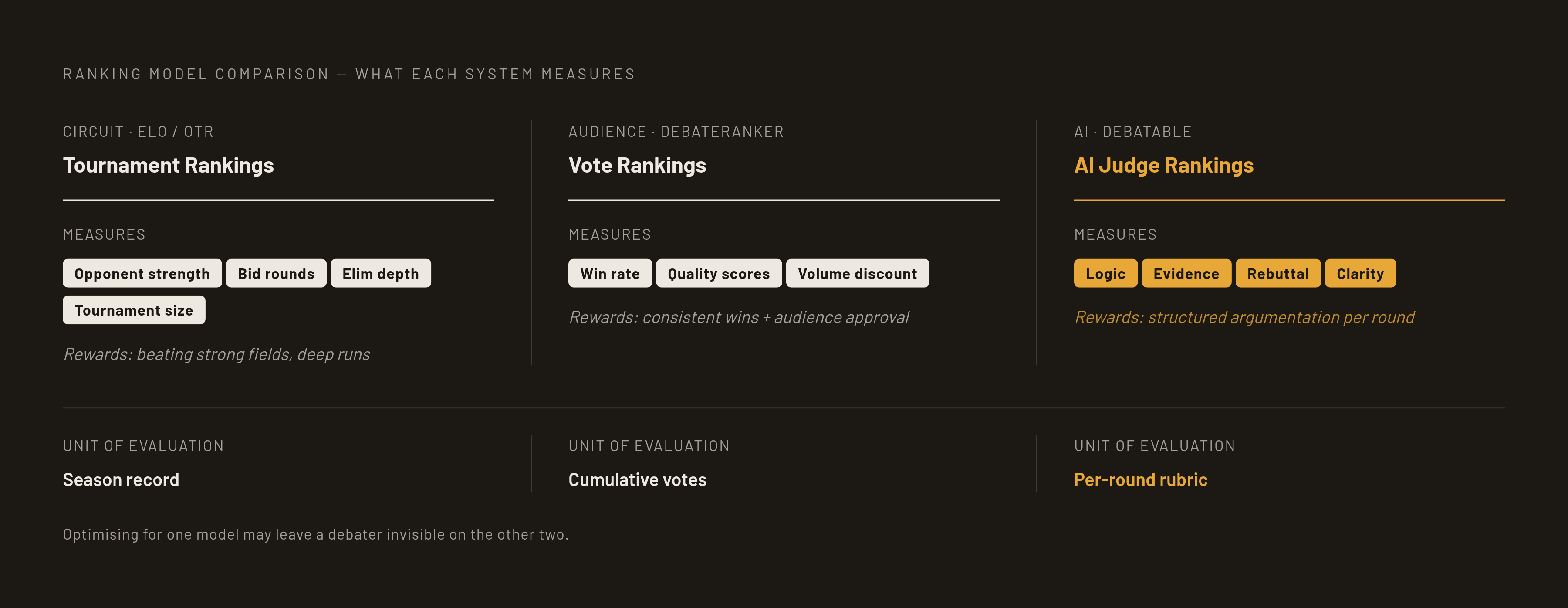
Tournament-aggregated rankings weigh results by how strong the opponents were and how far a debater got through the rounds. Audience-vote rankings mix audience scores with win rate, while AI-judged rankings use structured rubrics to score each debate after it ends. These are different definitions of performance. A formula that rewards deep tournament runs pushes debaters to compete in a different way from one that updates after every online round.
How tournament-circuit rankings handle the problem of opponent quality
Beating a strong opponent and beating a weak opponent produce the same raw result, but they provide different evidence of competitive strength. ELO-style and OTR-style systems address that problem by accounting for the opposition and the depth of a tournament run.
DebateDrills × NSD rankings use an ELO model for Public Forum and Lincoln-Douglas. Beating a higher-rated opponent earns more points, while losing to a lower-rated opponent costs more. Reaching elimination rounds earns a bonus scaled to tournament size, and ELO losses in those rounds are reduced. That gives debaters credit for getting past preliminaries even when they end their run with a close loss. Tournaments with more entries and more bids also receive proportionally more weight.
Debate Land uses its open-source OTR 3.0 Score to award points for scaled tournament attendance, deep elimination runs, and performance against difficult opponents. It covers PF and LD, with team and judge rankings. The unit being ranked also changes the interpretation. The National Debate Leaderboard DPI aggregates results at both individual and program level, producing a Debate Point Index that treats schools and colleges as competitive units.
These systems permit movement within a season. Millburn High School (NJ), for example, moved from 15th to 13th in the same season. But moving up still depends in part on going to tournaments often, which gives well-funded programs that travel a lot an edge. Opponent adjustment improves the comparison among recorded results, but it cannot give every debater equal access to the events that generate them.
What audience-vote rankings measure — and where the formula gets complicated
When audience members supply the judgment, a leaderboard measures persuasion before real people in real time rather than success in elimination rounds before credentialed judges. DebateRanker illustrates this model by blending audience scores with win rate. Tournament infrastructure is no longer the central reference point.
DebateRanker places public figures including Richard Dawkins, Christopher Hitchens, and Sam Harris on the same scale as community debaters including Charlie Kirk and Destiny. A rating can compare performances drawn from a debate culture whose participants do not all follow the same tournament pathway.
The blend introduces a consequential weighting choice. A debater who wins with modest quality scores can outrank someone who loses closely while scoring highly, depending on how the formula balances those inputs. Winning and scoring well are related, but they are not identical. A leaderboard that gives greater weight to win rate rewards converting a performance into a victory, while a stronger audience-score component gives more influence to how the crowd assesses that performance.
Volume discounting addresses a separate weakness in the sample. Without it, a debater could cherry-pick easy opponents and present a perfect record drawn from very few rounds. Discounting small samples reduces that gaming opportunity rather than treating every unbeaten record as equally persuasive evidence. The choice between quality scores and wins remains a decision about what the ranking is designed to reward.
How AI judging produces a score — and why the rubric has to be public before the round starts
AI-judged rankings replace aggregated tournament results or audience votes with a structured assessment of each completed debate. This removes judge availability as a bottleneck, but it moves the question of trust into the rubric. The score depends on the stated criteria. Without knowing those criteria, debaters cannot tell whether they did poorly or were judged by rules they did not expect.
RapiDevelopers’ AI debate platform overview describes a white-label system that uses real-time speech transcription along with LLM-based judging. Its rubrics cover logical-fallacy detection, evidence-grounding, rebuttal strength, and speaker clarity. At round end, the system scores each speaker and produces feedback explaining its reasoning.
Panel design adds another layer of scrutiny. Some platforms have more than one independent AI judge, each of which gives its own score and explains why. CourtEval describes a different, interactive approach with roles named Controller, Grader, Critic, and Defender, in which the Grader revises its initial score after hearing both sides. These arrangements should not be treated as interchangeable.
Debatable uses a three-model judge panel to produce a scored written decision after individual rounds, with completed debates updating the public leaderboard in real time. Its rules are made public before the debater speaks, so the criteria are set before the round starts. An explanation after the round is not enough if the debater did not know the standard during it.
Appealability gives that transparency a practical consequence. On Debatable, either side can appeal to a human reviewer. Published rules establish the benchmark, and review provides a route to challenge reasoning that does not track the actual arguments. Neither practice makes a score infallible. Together, they make it possible to assess whether the verdict followed the announced standard, which is the basis for treating it as useful evidence.
What debate platforms offer a leaderboard path to live creators and streamers?
On live platforms, leaderboard position can serve as a selection mechanism for broadcast debate. Debatable connects standings to consideration for creator and streamer matchups. Winning AI-judged rounds moves users up its public board, so taking part can lead to a chance to be picked.
When a creator or streamer wants a live opponent, the platform considers top-ranked users whose topics and availability fit. Selection also depends on creator participation and whether the challenger’s style suits the show. A high finish does not guarantee an invitation. Selected challengers debate on the creator’s channel with live judging, so scheduling and fit remain necessary even after competitive performance has put someone in consideration.
In a tournament circuit, ranking progress depends on recorded tournament appearances and their results. In this model, every judged round moves the rank, bringing practice and competition into the same activity. A debater is not merely rehearsing for a later event that will finally count toward selection. The round itself contributes to the record from which potential challengers are considered.
Destiny, whose name is Steven Bonnell, built a large audience through frequent live debates with political influencers, advocates, and academics, generating orbits of smaller creators around him. Live debate platforms are trying to make that path part of a set system. The distinction is that a public ranking supplies a defined basis for consideration, while the eventual broadcast still depends on the creator, the topic, and the available participants.
What the ranking system cannot see — the limits that apply to all three models
Every system measures the debater who showed up. Its results therefore reflect access, frequency, and format fit as well as underlying skill. Tournament ELO and OTR systems favor programs able to attend many high-bid events, leaving less-funded debaters with a narrower pool of scoring opportunities. Weighing results by opponent strength cannot build a record of rounds that someone had no chance to enter.
Audience-vote systems face a different constraint. A debater who shares the views of most of the community may get a higher persuasion score than someone who argues a minority position just as well. AI judging substitutes rubric dependence for that audience dependence. Where a rubric weights clarity and persuasion differently at different stages, it can favor front-loaded impact over technical rebuttal. Consistent application does not make the choice of criteria neutral.
Sample size remains a shared source of uncertainty. Volume discounting and elimination-round bonuses try to deal with parts of that problem, but neither solves it in full. A rating based on fewer rounds contains less evidence about performance. These limits make a position on the board a partial account of a debater’s ability.
Choosing a ranking environment that actually reflects how you are improving
The practical choice begins with the skill being developed. For competitive high school debaters on the national circuit, DebateDrills × NSD and Debate Land offer transparent, open-source methodologies for PF and LD. Comparing positions across both is more informative than relying on either alone, because their formulas weight the competitive record differently.
Audience-weighted rankings suit a different objective. For someone working on persuasion before a live crowd, audience scores provide evidence that tournament placement alone cannot supply. It helps to check how much those scores count toward the rating alongside wins and the number of rounds played. That helps show whether a higher rating comes from better audience scores or more wins, even when both count toward the same rating.
For debaters who cannot get to tournaments often, open AI-judged rounds make it easier to get scores and feedback again and again. Individual rounds on Debatable start immediately against an AI or a live opponent and produce a written decision from its three-model panel. Its Individual plan costs $10 a year and comes with 120 AI voice minutes each month. Free live rounds with human opponents provide an access point outside a full tournament weekend.
Before competing on any board, a debater should ask whether the criteria are published before the round, whether the system adjusts for opponent quality, and whether a higher rank reflects more rounds or better rounds. A leaderboard becomes a stronger tool for improvement when each result includes written feedback citing what was actually said. The number then sits beside a record of the judges’ reasoning, allowing the debater to use each round as evidence for what to improve next.