Debate Platforms Built for High School Teams
On-demand judged rounds give under-resourced teams the practice infrastructure money can't buy.
The gap between a strong debate program and a struggling one has less to do with how smart the students are and more to do with what surrounds them: coaching that shows up every week, a steady stream of tournaments, and years of research handed down from older debaters who have already built the cases. A well-funded program gives its students regular coached rounds, consistent tournament exposure, and a library of prior work to draw on. A Title I school, or any under-resourced team, often arrives at the same tournament without any of that, and the disadvantage sets in before a single speech gets made. Debate works more like a sport than a club: it takes regular practice with feedback, not occasional after-school meetings, and a student dropped into a competitive bracket without active coaching is facing opponents who have had both for years. No platform can stand in for a dedicated coach, but a platform can deliver the one resource that under-resourced teams lack most, which is a judged practice round, available on demand, that doesn't depend on a school's budget or its zip code. That reframes what matters when choosing a tool. The right platform is the one that gets a real judged round in front of any student, at any time, for little or no cost, not the one stocked with the most prep material or the biggest case library.
What debate formats demand from practice
Every major debate format builds a different set of skills, and a platform that treats "debate" as one undifferentiated activity will fail students in whichever format their team actually competes in. Lincoln-Douglas is one-on-one and built around values-based argumentation, so the practice demand is almost entirely individual: a student has to speak and reason under time pressure with no partner to lean on if a round goes badly. Policy debate runs the opposite way. Teams work one broad resolution across an entire year, and the format rewards deep research over quick thinking. A recent Arctic-themed topic alone produced cases on oil drilling, indigenous rights, military presence, shipping lanes, and environmental protection. Practice has to support real case development specific to the topic at hand. The practical consequence is straightforward: a platform worth using has to let students practice the specific format their team runs, and it has to produce feedback calibrated to that format's own criteria, not a generic scorecard that treats every round the same way.
Why spoken, judged rounds are the core practice need
Debate improvement is a speaking problem before it's a knowledge problem, and the single mechanism that closes the gap fastest is a judged round with real feedback attached, not another packet of evidence or another night of silent prep. Three habits move a debater's performance from one tournament to the next: watching recordings of their own speeches, practicing impromptu rebuttals against motions they've never seen, and reading judge feedback closely enough to spot patterns across rounds. All three depend on having a completed round to work from. Specific fluency drills build the mechanics that a judged round then puts to the test: speaking continuously on a random word without filler sounds, a drill sometimes called "UmOlympics," or restarting a speech from the top every time a fluency break occurs, known as "Start Stops." A platform that offers drills like these without ever producing a judged round leaves a student with mechanics and no way to see whether those mechanics hold up under pressure. The rebuttal is where most rounds actually get decided: the winning move is listening closely enough to catch an opponent's specific claims and the evidence propping each one up, then attacking the weakest link, and that is a skill that can only be trained against a live or realistic opposing argument, never against a static page of text. Under-resourced teams rarely have enough experienced members or coaches on hand to run full internal practice rounds, so a platform that supplies an on-demand opponent, whether human or AI, and returns a scored verdict afterward is standing in for infrastructure those teams simply don't have. Recording and reviewing one's own speeches closes a loop that most informal team practices leave wide open, because few students outside a well-staffed program ever get to watch themselves back and compare that tape against a judge's actual reasoning. What's scarce is a judge willing to sit through a practice round and hand back detailed, honest feedback, a scarcity that AI judging exists to address.
AI judging for high school teams
AI judging earns its place in a high school team's practice routine not as a stand-in for competition itself, but as practice infrastructure that scales: consistent, rubric-based feedback after every round, at any hour, with no human judge needing to be in the room. The underlying mechanism scores a speech on clarity (jargon, run-on sentences, ambiguous phrasing), relevance (whether an argument actually answers the topic or the opponent's last point), and evidence quality (whether a claim is backed by facts, examples, or sound reasoning), criteria that track closely with what human judges already look for. Consistency is where AI judging earns its keep in practice specifically: it runs the same rubric on every round, so a student who debates fifty practice rounds gets fifty verdicts that can actually be compared to one another. Human judges shift with mood, fatigue, and personal style in ways that can hide the very patterns a student needs to see. When the scoring criteria are published before the round starts and the verdict points to specific things that were actually said, a student can trace a low score back to one weak argument. Debatable's scorecard scores completed rounds across six axes, including the strength of the argument itself, how well a debater responds to the other side's case, and the clarity and structure of the delivery, so a student can see precisely where a round was won or lost. AI struggles with genuinely novel lines of argument, and it can inherit the biases of its training data toward whatever rhetorical style is already dominant. Research on machine adjudication is mixed. A systematic review of 58 empirical studies found ambiguous results on whether people trust algorithms or humans more as judges, though one key paper focused on legal and bureaucratic settings did find that people regard algorithmic decisions as less fair, a pattern that doesn't hold universally across every context. Hybrid approaches, where a human reviews an algorithmic recommendation before finalizing it, narrow that gap substantially. One study of judicial hybrid procedures found the hybrid approach closed the fairness gap entirely for White and conservative participants, but only partially for Black and liberal participants, which suggests the fix helps without erasing the underlying problem. The sensible conclusion for a team is to treat AI judging as the right tool for practice rounds and skill-building, while keeping human judging as the standard for high-stakes competition. A fallacy-detection feature that flags an ad hominem attack, a straw man, or a false dilemma, and explains why it counts as one rather than simply penalizing it, turns an ordinary practice round into a logic lesson, which matters most for newer debaters who haven't yet internalized what a sound argument structure actually looks like.
A progression from solo AI rounds to live 1v1 to competitive play
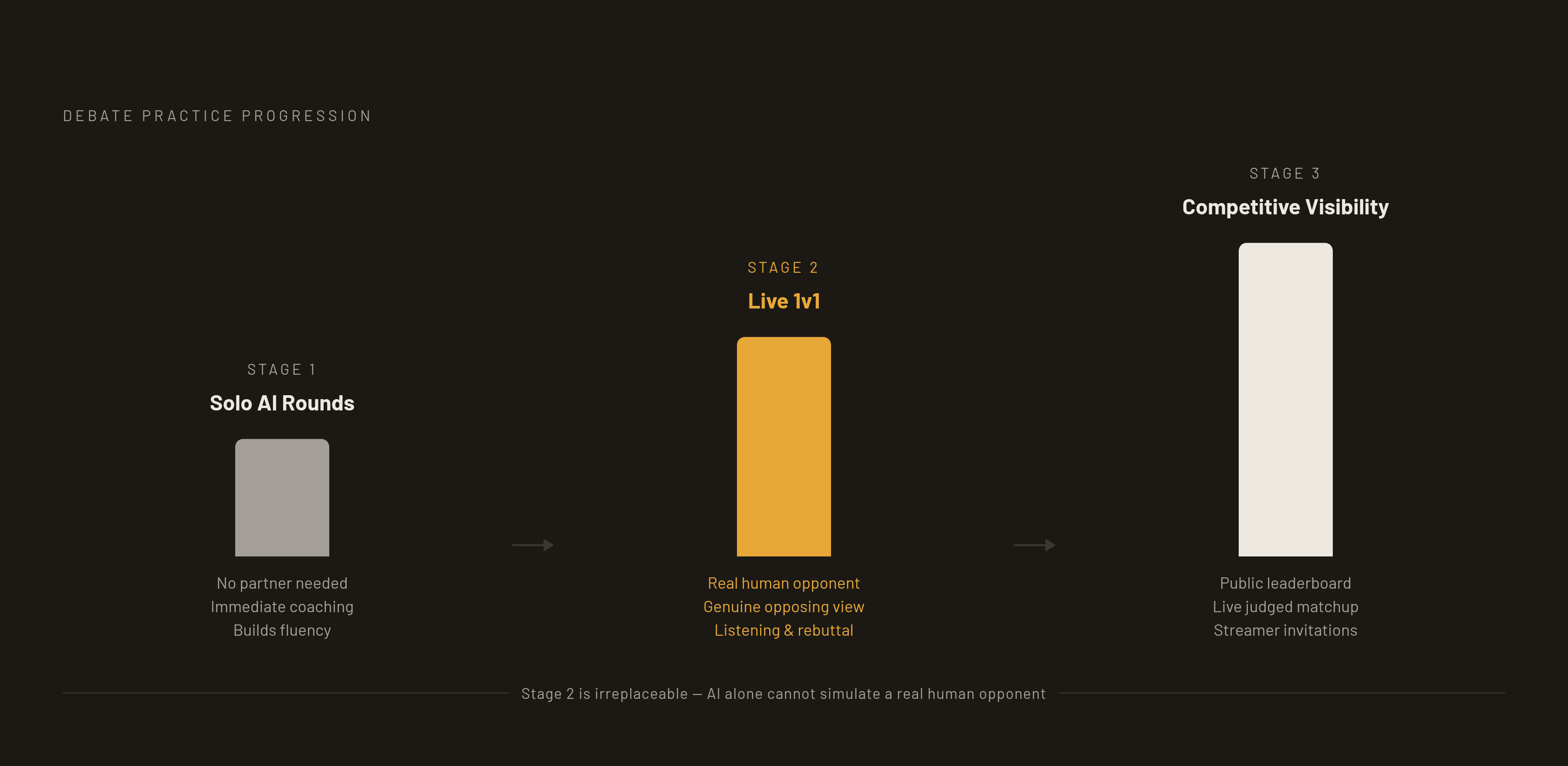
A platform built for a high school team needs to support three distinct stages of practice at once, because different students on the same roster are sitting at different points in that progression on any given day. Solo AI rounds work as the entry point: a student can start right away without waiting on a partner or a scheduled opponent, get coaching feedback immediately, and build basic speaking fluency somewhere the stakes are low. That matters most for first-year debaters on a team that's facing off against programs stocked with several experienced returners. Live 1v1 sits in the middle and comes closest to simulating actual tournament conditions: a real person on the other side holds a genuine opposing view, nothing about the exchange is scripted, and the pressure of being heard and challenged in real time trains the listening and rebuttal instincts that an AI opponent can approximate but never fully replace. At the top of that progression sits competitive visibility, the kind that comes from a transparent ranking system and, for the strongest performers, a shot at something bigger. Debatable's structure covers all three stages directly, and its top tier takes a distinctive shape: a public leaderboard where strong, consistent performance can lead to an invitation to debate a streamer or content creator in a live, judged matchup. Reaching that stage depends on a combination of leaderboard standing, whether a student's style fits the topic at hand, and whether both sides can actually make the scheduled time, so a high rank raises the odds of an invitation without guaranteeing one. That structure, moving from solo rounds to live human opponents to a visible competitive ladder with a genuine incentive at the top, gives a team a reason to keep practicing through an entire season rather than cramming in the two weeks before a tournament.
The competition calendar a high school team is training toward
The high school debate calendar runs dense and front-loaded with qualifying pressure, so a team that starts building platform-supported practice habits in September will show up measurably more prepared than a team that treats the platform as something extra. The tournament ladder climbs from local and regional qualifiers through a handful of prestigious invitationals up to national championships, and each rung demands a higher level of preparation than the one before it. Teams that have already logged consistent judged practice rounds carry real feedback patterns into that climb. One of the most prestigious national invitationals runs annually over a long winter weekend and ranks among the most prestigious qualifying tournaments for the national championship series: teams that reach the round of 16 in the high school varsity division earn a qualifying bid, and the event draws competitors from across the country in multiple debate events. The Glenbrooks Tournament, hosted jointly by Glenbrook North and Glenbrook South High Schools near Chicago, runs in November and functions as a crucial mid-season checkpoint, its timing giving teams room to refine their cases before the major winter tournaments while still offering TOC bids of its own. Topic selection shapes the entire season of practice leading up to these events. One format's teams work subsets of one broad year-long resolution, while the other format's topics rotate far more often, so a platform that lets students practice on the actual resolutions their team is preparing is worth considerably more than one that only offers generic prompts. The NFHS has already announced its five policy topic finalists for 2026-27: carbon pricing, antitrust liability expansion, national health insurance, nuclear arsenal reduction, and a domestic renewable energy market instrument. Teams that begin platform-based practice early can log rounds against these specific themes well before the first tournament of the season arrives. Canadian teams should note that Ontario's provincial tournament dates run on their own separate schedule from the U.S. national calendar described above, and should plan their practice timeline against that schedule instead.
Platform selection criteria for a high school team
Everything this piece has laid out, the resource gap, the differences between formats, the scarcity of judged practice, the case for AI judging, and the shape of a full practice progression, points toward a short list of criteria that actually matter when a coach sits down to choose a platform. The first is real judged rounds on demand: a platform needs to return a scored verdict after every session, publish its criteria before the round begins, and ground its decision in what a student actually said, so that feedback is something a student can act on. The second is access to human opponents, not AI alone: live 1v1 matchmaking against a real person holding a genuine opposing view trains listening, rebuttal, and pressure management in a way no AI opponent can fully substitute for, so a platform built entirely around AI falls short of preparing a student for what a tournament round actually feels like. The third is an honest ranking system, something like a rating that adjusts based on performance against opponents of real, varying strength, which gives a student an actual signal of where they stand. The fourth is accessibility and cost: a platform that locks its core practice features behind an expensive subscription or an institutional account ends up recreating the very resource gap it was supposed to close, and the right tool stays available to a student regardless of what their school can afford. None of this erases the value of an experienced coach standing beside a student between rounds at an actual tournament, and no AI judge is equivalent to a qualified human judge when the stakes are highest. But daily and weekly practice volume is what readies a student for those tournaments, and for that volume, a platform delivering real judged rounds on demand stands as the closest substitute available for infrastructure most schools cannot afford to hire. Judged by that standard, Debatable's pricing reflects the same principle directly: an individual plan runs $10 a year, with a $12-a-month voice option covering the same 120 minutes of AI voice practice, a structure built around keeping the practice itself within reach. Closing the resource gap described at the start of this piece is the real test any platform should be measured against, and the tools that pass that test are the ones that make judged, spoken practice available to every student, not just the ones whose schools could already afford it.